Farming in the desert: How the UAE is scaling vertical & hydroponic agriculture

Farming in the desert: How the UAE is scaling vertical & hydroponic agriculture

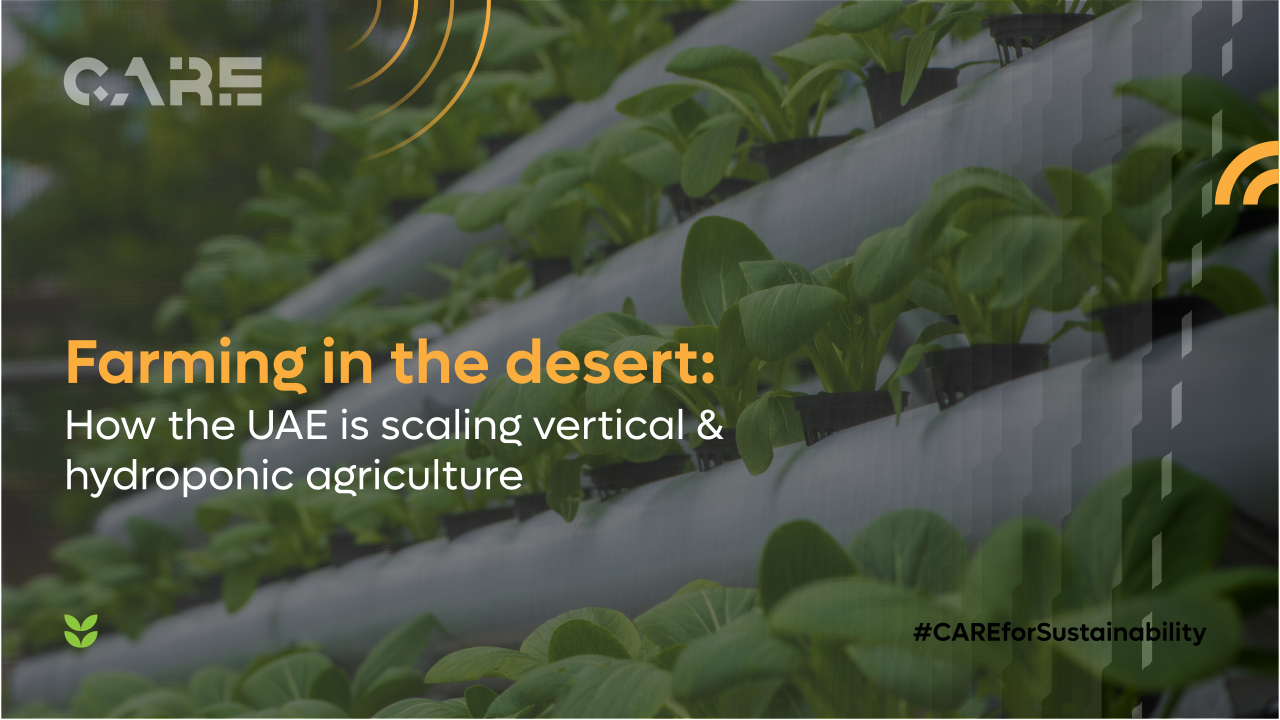
The UAE imports approximately 85% of its food, making food security a critical national concern. In a country with limited arable land and scarce water resources, traditional agriculture cannot meet domestic demand. To overcome these challenges, the UAE is turning to vertical farming, hydroponics, and high-tech controlled-environment agriculture as scalable, sustainable solutions.

Rethinking agriculture for the desert

High temperatures, saline soil, and minimal rainfall make conventional farming difficult in the Gulf. To address this, vertical farming and hydroponic systems are being deployed, which allow crops to grow in stacked layers or nutrient-rich water rather than soil. These methods drastically reduce land usage and water consumption while enabling farms to be located closer to cities, cutting down transportation needs and ensuring fresher produce.

Hydroponics alone can reduce water use by up to 90% compared to soil-based farming. Vertical farming offers year-round production and reduces the need for pesticides, making it a cleaner, more reliable way to produce food in desert climates.

Big investments, bigger yields

The UAE has made large-scale investments to support this transition. Dubai hosts Emirates Crop One, the world’s largest vertical farm. This $40 million facility produces over 1 million kilograms of leafy greens annually, while using 95% less water than conventional agriculture. Abu Dhabi has allocated $272 millionto support indoor farming start-ups, further accelerating innovation and domestic production capacity.

In 2023, Pure Harvest Smart Farms, a UAE-based agri-tech company, raised over $180 millionto expand climate-controlled farming across the region. These investments position the UAE as a hub for innovation in desert agriculture and signal to global investors that controlled-environment agriculture is a viable, scalable solution.

Beyond leafy greens

While initial focus has been on high-value crops such as lettuce, spinach, and herbs, the UAE is experimenting with other crops like tomatoes, strawberries, and root vegetables. Some farms are exploring aquaponics, which integrates fish farming with hydroponic systems, creating a closed-loop ecosystem where nutrient waste from fish feeds plants. These approaches expand the variety of crops that can be grown sustainably in the desert.

Advanced technologies such as AI and IoT are also being applied to optimise nutrient delivery, water usage, and energy efficiency. Sensors track plant growth and environmental conditions in real-time, allowing farmers to maximise yields while minimising waste. These innovations reduce costs, lower emissions, and generate valuable data to further scale desert farming across the region.

Climate action through food security

Scaling vertical and hydroponic farming is not just about increasing domestic food production. It also significantly contributes to climate action. Local production reduces the need for imported food, lowering transportation-related emissions. It also ensures more resilient supply chains in a region vulnerable to climate shocks, water scarcity, and geopolitical risks.

This strategy aligns with the UAE’s National Food Security Strategy 2051, which aims to place the country among the top 10 most food-secure nations globally by 2051.

Why this matters for CARE

The UAE’s desert farming initiatives demonstrate that sustainability encompasses more than energy or transport solutions. They show how innovation, investment, and technology can transform one of the world’s most challenging climates into a productive agricultural hub.

At CARE 2025 (Climate Action, Renewable Energy & Sustainability Forum), food security is a central theme. From vertical farms and hydroponics to climate-smart agriculture, CARE connects policymakers, investors, and innovators to share insights, explore collaborations, and scale solutions. These developments serve as a blueprint for other arid regions seeking sustainable food production.

If farming can thrive in the desert, it can thrive anywhere.
Register today.

Learn about News & Events

More Articles

28/10/2025
The MENA renewable energy pipeline is the finest area in the world for development. By 2027, 85% of the region’s renewable energy capacity will come from five main markets: Saudi Arabia, the UAE, Egypt, Morocco, and Oman. These nations will add more than 75 GW of additional solar and wind power, which will cost more […]
28/10/2025
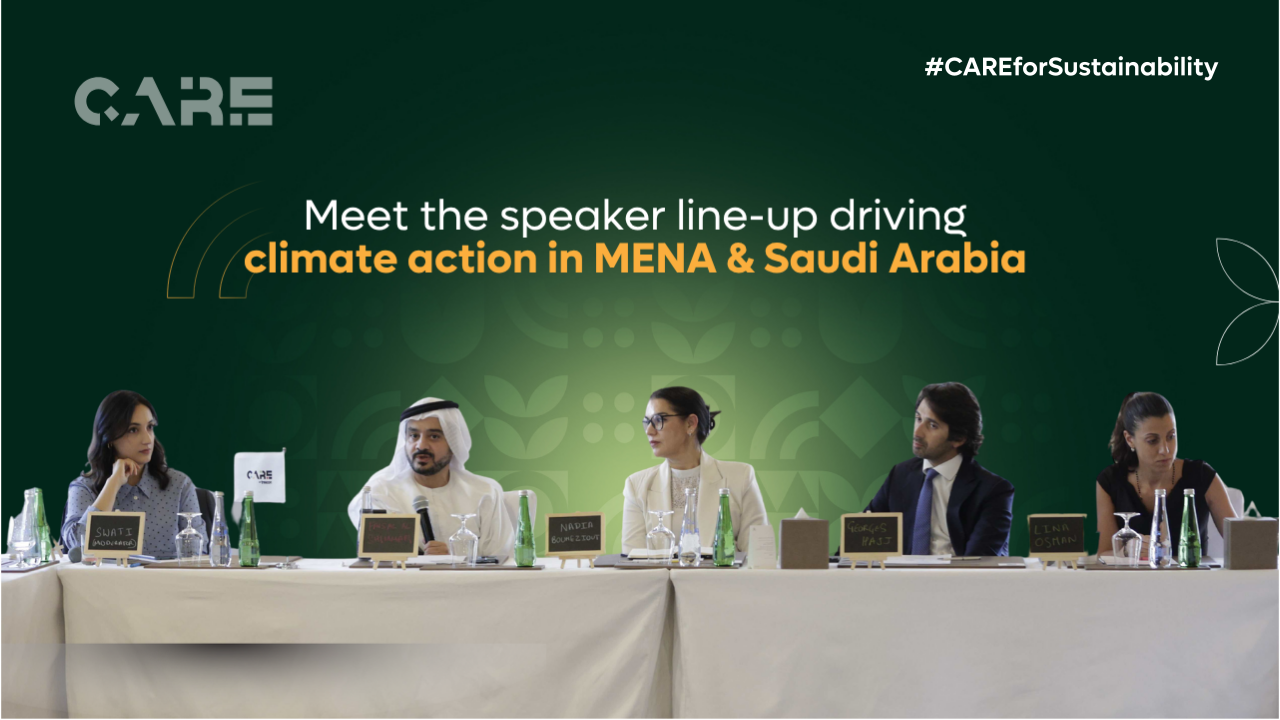
If you thought CARE was just another conference, think again. We’re proud to present a world-class roster of speakers for the MENA and KSA editions – strategists, innovators and decision-makers who don’t just talk sustainability, they execute it. The MENA stage: Driving regional transformation From the UAE to Lebanon, Egypt to Kuwait, the MENA edition […]
22/10/2025
Executive Summary The climate tech market globally is growing sharply with a projected Compound Annual Growth Rate (CAGR) of ~24-25% from 2025 through ~2032/2035. In the MENA & Turkey region, venture capital (VC) investment in climate tech has reached US$651 million over 2018-2022, across ~148 startups. The UAE leads regionally, attracting ~62% (≈ US$401 million) […]
22/10/2025
For decades, the Middle East was defined by oil. The world’s engines ran on its crude, and its economies grew in its shadow. But oil is not forever. Prices swing, reserves deplete, and the global race to Net Zero is forcing even the richest producers to rethink what comes next.  Now, a new story is […]
15/10/2025
The UAE imports approximately 85% of its food, making food security a critical national concern. In a country with limited arable land and scarce water resources, traditional agriculture cannot meet domestic demand. To overcome these challenges, the UAE is turning to vertical farming, hydroponics, and high-tech controlled-environment agriculture as scalable, sustainable solutions. Rethinking agriculture for […]
26/09/2025
The Middle East and North Africa (MENA) region is writing the biggest chapter in the green hydrogen story. With more than $150 billion committed across 15 countries, the region has become the world’s most ambitious hub for large-scale hydrogen production and export.  The headline numbers are staggering.   Saudi Arabia’s $110 billion NEOM development, the UAE’s […]
11/09/2025
If you’ve been to enough climate events, you know the pattern. Big promises, inspiring speeches… and then? Not much changes.  CARE, Climate Action & Renewable Energy Expo, is different.  Launching in Dubai (26–27 November 2025) followed by Riyadh (8–9 December 2025), CARE is where the MENA region’s climate commitments are matched with real, measurable outcomes. […]
29/08/2025
The global energy transition is accelerating, and the Middle East and North Africa (MENA) region is fast emerging as a leader in renewable energy deployment. At the forefront of this movement stands the Middle East Solar Industry Association (MESIA); the region’s largest and most influential solar association.  As the official association partner for CARE MENA […]
06/08/2025
In a region known for oil and gas, the clean energy race is officially on. Across the Middle East and North Africa (MENA), governments are pumping billions into renewables. The pledges are loud. But who’s actually delivering? This isn’t about net zero PR. It’s about real generation capacity, infrastructure on the ground, and projects that […]
06/08/2025
Gulf economies are sitting on oil wealth. Now they’re betting heavily on climate capital. Green financing is gathering speed. Investment appetite is shifting. And the Gulf is vying to be a global hub for sustainable finance.    Gulf green bond issuance is breaking records  In 2023, the UAE and Saudi Arabia together issued about $16.1 billion […]
11/07/2025
Money is pouring into MENA’s climate ambitions.   In 2023 alone, the region issued a record $24 billion in green, social, and sustainability bonds, a 155% jump from the previous year. Governments from the UAE to Saudi Arabia have set bold net-zero targets, committing billions to clean energy megaprojects and green infrastructure.  But when it comes […]
03/07/2025
The global race to cut emissions isn’t going to be won in Brussels or San Francisco. It might be won in the deserts of Saudi Arabia, on the rooftops of Cairo, or in the labs of Abu Dhabi.  The Middle East and North Africa (MENA) are no longer just reacting to climate change; they’re designing […]
28/09/2023
Introduction: In the realm of technology, a powerful movement is underway that transcends innovation—it’s the embodiment of our commitment to a greener, more sustainable world. Introducing the “Green Quotient,” a term that encapsulates the collective effort to harness technology for the betterment of our planet. This theme embraces Electric Vehicles (EVs), Alternative Energy, Recycling Technology, and […]