The Middle East’s next global export isn’t oil. It’s water tech

The Middle East’s next global export isn’t oil. It’s water tech

From oil to water tech: The region’s next big export 

For decades, the Middle East was defined by oil. The world’s engines ran on its crude, and its economies grew in its shadow. But oil is not forever. Prices swing, reserves deplete, and the global race to Net Zero is forcing even the richest producers to rethink what comes next. 

Now, a new story is being written. From Riyadh to Dubai, the region is turning its hardest challenge, water scarcity, into its most promising opportunity. What was once a survival issue is becoming an economic asset. The next great export from the Middle East may not be barrels of oil but breakthroughs in water technology. 

Scarcity breeds ingenuity 

In a land where fresh water is precious, necessity has become the mother of invention. The Gulf countries now account for about 40% of the world’s desalinated water capacity, turning survival into expertise (Time). What started as an existential challenge is now shaping up to be a multi-billion-dollar industry. 

Desalination becomes trade 

The rise of solar-powered reverse osmosis plants is rewriting the economics of desalination. At Dubai’s Hassyan facility, desalinated water will cost just $0.37 per cubic metre – compare that to London’s £1.00. That price shift makes Gulf-built solutions globally competitive (FT). 

The global desalination market is forecast to grow 8% annually through 2030, hitting nearly $39 billion. With the Middle East already running the world’s most advanced plants, its companies are set to lead the export surge. 

Investment flooding in 

Saudi Arabia is leading the charge. The Kingdom has announced $9.33 billion across 60 new projects that will almost triple desalination capacity to 7.5 million cubic metres per day by 2027 (Zawya). In 2024 alone, Saudi water-sector contracts reached $14.9 billion — double its average annual spend in recent years (MEED). 

The UAE isn’t far behind. The Hassyan desalination plant, due in 2026, will be the world’s most energy-efficient, supplying two million people while consuming just 2.9 kWh per cubic metre (WSJ). 

Beyond desalination: Water tech 2.0 

It’s not just mega-plants. Start-ups are entering the scene with smart water grids, AI-driven leakage detection, and low-energy purification systems. Masdar has trialled solar desalination powered entirely by renewables, showing how innovation can scale sustainably. Israeli firms are exporting drip-irrigation and wastewater recycling models, while Gulf innovators refine tech for harsher climates. 

Together, these solutions position the region not only as a water-secure zone but as a global hub for climate-resilient water technology. 

Strategy meets sustainability 

Unlike oil, exporting water technology doesn’t come with a carbon burden. These solutions preserve ecosystems, enable agriculture, and reduce conflict over scarce resources. For governments under pressure to diversify, water tech offers both resilience and revenue. 

CARE and the water tech revolution 

At CARE – Climate Action, Renewable Energy & Sustainability Forum, we see water innovation as the region’s clearest pathway beyond hydrocarbons. The expertise born from scarcity is now a powerful export, one the world urgently needs. 

The oil age taught the world to look to the Middle East for energy. The water age will teach it to look here for solutions. 

Register today with CARE and be part of the conversation on water tech — the region’s boldest export yet. 
 

Learn about News & Events

More Articles

28/10/2025
The MENA renewable energy pipeline is the finest area in the world for development. By 2027, 85% of the region’s renewable energy capacity will come from five main markets: Saudi Arabia, the UAE, Egypt, Morocco, and Oman. These nations will add more than 75 GW of additional solar and wind power, which will cost more […]
28/10/2025
The Kingdom’s main goal for the environment, after using more renewable energy, is to cut down on carbon emissions from its industries. It would cost more than $25 billion to change heavy sectors like petrochemicals, steel, cement, and aluminium manufacturing such that they emit 130 million tonnes less CO2 per year by 2030. The Saudi […]
28/10/2025
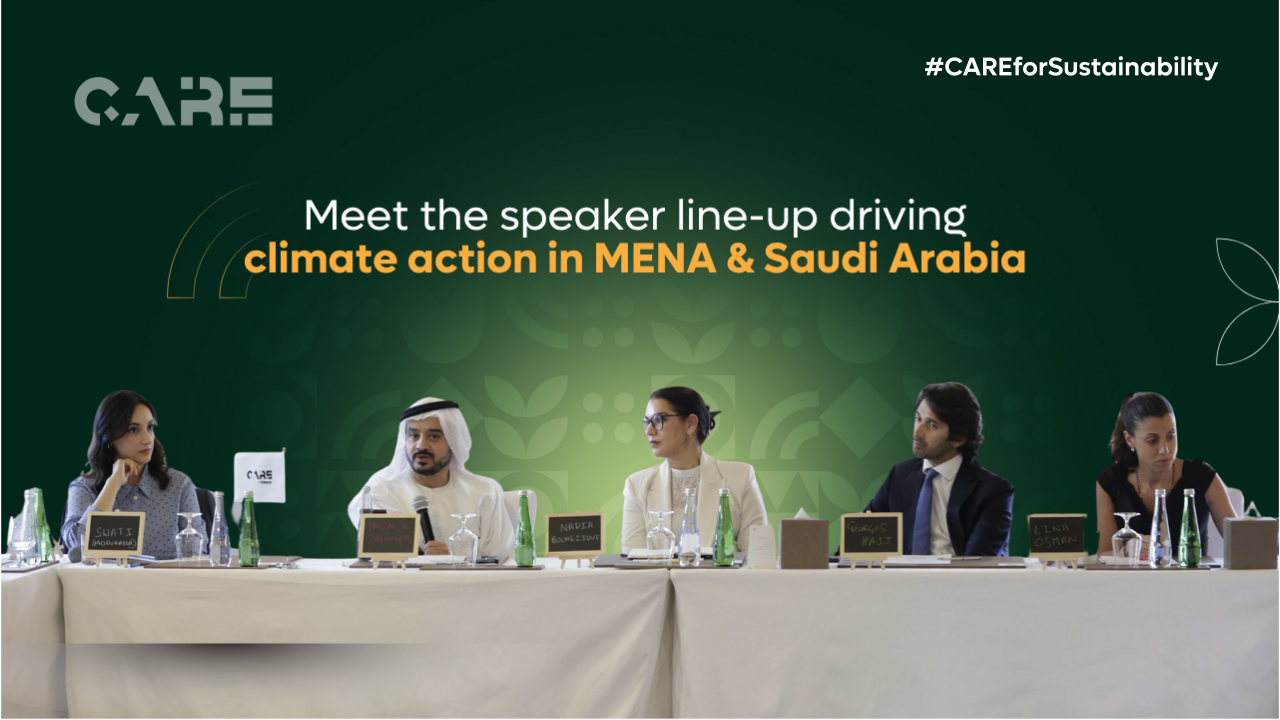
If you thought CARE was just another conference, think again. We’re proud to present a world-class roster of speakers for the MENA and KSA editions – strategists, innovators and decision-makers who don’t just talk sustainability, they execute it. The MENA stage: Driving regional transformation From the UAE to Lebanon, Egypt to Kuwait, the MENA edition […]
22/10/2025
Executive summary The Red Sea coastline (Saudi Arabia and neighbouring Red Sea states) and the U.S. Gulf Coast (Texas, Louisiana and adjacent waters) are rapidly emerging as two complementary renewable-energy fronts in 2025. The Red Sea corridor is focused on utility-scale solar, hybrid wind + solar + storage, and green-hydrogen value chains (anchored by mega-projects […]
22/10/2025
From oil to water tech: The region’s next big export  For decades, the Middle East was defined by oil. The world’s engines ran on its crude, and its economies grew in its shadow. But oil is not forever. Prices swing, reserves deplete, and the global race to Net Zero is forcing even the richest producers […]
22/10/2025
Executive Summary The climate tech market globally is growing sharply with a projected Compound Annual Growth Rate (CAGR) of ~24-25% from 2025 through ~2032/2035. In the MENA & Turkey region, venture capital (VC) investment in climate tech has reached US$651 million over 2018-2022, across ~148 startups. The UAE leads regionally, attracting ~62% (≈ US$401 million) […]
01/10/2025
In-depth focus on advancements in sustainable power sources across MENA.
01/10/2025
Defining key priorities for environmental progress in the year ahead.
01/10/2025
International experts outline strategies for ethical and sustainable business.
01/10/2025
Innovative circular economy approaches transforming energy sectors.
01/10/2025
Massive funding propels Saudi Arabia’s ambitious renewable energy agenda.
01/10/2025
Connecting regulations with viable business opportunities in green technology.
01/10/2025
Advancing eco-friendly transportation solutions across the region.
01/10/2025
Emerging patterns in clean energy discussed by industry leaders in Dubai.
01/10/2025
Turning conversations into actionable investments for Dubai’s sustainable growth.
01/10/2025
Pathways to achieving half of energy needs from sustainable sources in Saudi Arabia.
01/10/2025
Boosting Saudi Arabia’s diversification with renewable energy at the forefront.
01/10/2025
UAE’s vision for a sustainable tomorrow through expert insights and collaborative efforts.
01/10/2025
Expanding innovative solutions to combat climate change on a global scale.
29/09/2025
Key conversations accelerating progress toward net-zero goals in the coming months.
29/09/2025
Highlighting the Middle East’s role in advancing renewable energy initiatives and technologies.
29/09/2025
Thousands of influencers collaborate on impactful environmental, social, and governance investments.
29/09/2025
Saudi Arabia leads the charge in sustainable energy with massive investments driving environmental transformation.
29/09/2025
Saudi Arabia leads the charge in sustainable energy with massive investments driving environmental transformation.
26/09/2025
The Saudi Green Initiative is the Kingdom’s largest effort to make the environment better. It plans to spend $187 billion, which would decrease carbon emissions by 20 million tonnes a year by 2030. This will make Saudi Arabia a global leader in climate action and sustainable development. This big project is part of Crown Prince […]
26/09/2025
Saudi Arabia is not just talking about renewable energy; it’s building it at scale. With a transformative $32 billion investment pipeline, the Kingdom is setting the stage to become a global leader in sustainable energy by 2030.  A vision in action  Under Vision 2030, Saudi Arabia aims to generate 50% of its electricity from renewable […]
26/09/2025
With more than $32 billion going to renewable energy projects, the UAE and Saudi Arabia are at the forefront of the global green energy revolution. This means that the Gulf area has the fastest-growing sustainable energy industry in the world. It also indicates that nations with a lot of oil can switch to economies that […]
26/09/2025
The Middle East and North Africa (MENA) region is writing the biggest chapter in the green hydrogen story. With more than $150 billion committed across 15 countries, the region has become the world’s most ambitious hub for large-scale hydrogen production and export.  The headline numbers are staggering.   Saudi Arabia’s $110 billion NEOM development, the UAE’s […]
17/09/2025
The NEOM green hydrogen project represents the crown jewel of Saudi Arabia’s ambitious transformation under Vision 2030, showcasing the Kingdom’s commitment to becoming a global leader in sustainable energy. This $5 billion mega-project will produce 650 tonnes of carbon-free hydrogen daily, positioning Saudi Arabia at the forefront of the global green hydrogen economy while fundamentally […]
17/09/2025
The Middle East and North Africa (MENA) region is experiencing the world’s largest green energy transformation, with over $150 billion committed to green hydrogen investments alone. This massive shift represents the most significant economic diversification in the region’s modern history, creating unprecedented opportunities for investors, businesses, and climate tech innovators across the MENA sustainability landscape. […]